
Material Girl

By Ali Baylay

A VENUS PRODUCTION, STARRING:Yvonne Nelson, John Dumelo, Kofi Adjorlolo, Amonebea Dodoo, Gavivina Tamaklo, Brenda Osei Bonsu; Production Manager: Loius Saah Acquahman; Story: Abdul Salam Mumuni: Screenplay: Phil Efe Bernard; Continuity: Maxwell Awuni; Editor: Dapo-Ola Daniels; DOP: Adams Umar; Associate Producer: Roger Quartey; Producer/Executive Producer: Abdul Salam Mumini; Director: Frank Raja Arasi; 144 mins. C2009.

I believe Material Girl is more like a treatise in philosophy 101, than a simple drama. The movie is replete with the word ‘moral, morality’ to a point that the drama takes a second place in the presentation. I do not think Material Girl is a movie about good versus evil as the theme suggests. It is a movie based on evil versus evil. All major characters are existentialists by creed. To vindicate this claim, Cassie in one of her tirades declares: “life doesn’t give to those who ask, it gives to those who demand”.

The story goes like this: Cassie (Yvonne Nelson) gets paid after sleeping with an older gentleman in a hotel room and runs from the scene with a briefcase she thinks is full of money, asks a lift from a car passing by and later steals the driver’s cell phone. She’s disappointed by the discovery that the briefcase holds nothing but documents. She later visits her bedridden sick mother who would not take her daughter’s ill-begotten money for her treatment.

Hon. Jayke falls in love with Cassie after finding out she rescues his wife Jessica (Amanobea Dodoo) from collapsing outside their mansion. They both enjoy their secret rendezvous. Hon. Jayke buys Cassie a house and even  helps procure a government contract for her. Meanwhile, Cassie’s mother is on her deathbed in a hospital where the doctor refuses her treatment because she does not have money. Cassie’s younger sister prostitutes herself to her uncle just so she can raise money for her mother’s medical cost, but ends up with a bounced check. She still tries to steal money and got beat up and ends up in comma in the same hospital their mother is admitted. After pulling out of the comma, she goes and kills the uncle.

On the other side of the spectrum, Cassie is having a ball, shopping and basking in the good life as the Honorable Minister asks his wife Jessica to dissolve their 29 years of marriage. He wants to marry Cassie and live happily ever after. Unfortunately, his only son, Greg, character played by up and coming Gollywood star, John Dumelo gets in town from America and Cassie dates him. Jessica, hires a private eye to investigate reason for her husband’s estrangement, while Hon. Jayke too hires a hit man to kill any one that has come between him and Cassie for her strange disappearances. With not enough time left for both parents, Jessica finds out her son and husband are having affair with the same girl-Cassie. “I brought a serpent into my home”, she laments. For Hon. Jayke, he’s now living on a borrowed times beacause the hit men hired by him are presently stabbing  his only son to death, caught in the arms of Cassie. 

The last Koffie Adjorolo’s movie I reviewed was Sleepwalker in which a woman, (Genevieve Nnaji) three times less than his age ritualistically murders him in bed,while chasing after his lost (lust?) youth. In Material Girl too,he’s in search of the same lost youth, a friend asks him why going after a younger girlfriend, he says “not doing it out of nostalgia, I’m simply making a discovery”. Here’s such a cruel discovery in the hands of his one time movie daughter in Princess Tyra. “The wishes of mortals the gods command” as she would assert in Princess Tyra. Here, Cassie carries with her the same air of insolence to the point of fooling all the people all the time to her selfish gains but only this time stopping short in the face of a morass she helps orchestrate.

» No Comments

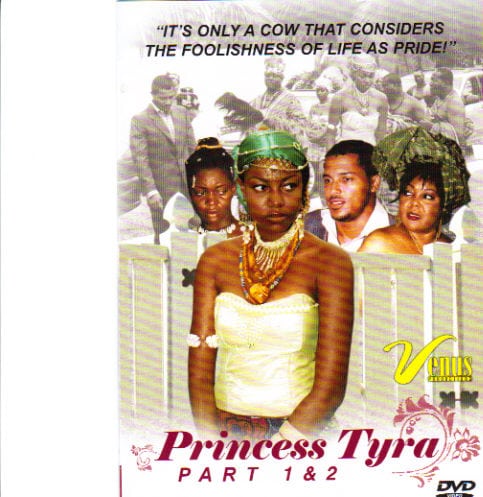
Princess Tyra

By Ali Baylay

A Venus Film productions.Starring: Van Vicker, Jackie Appiah, Kofi Adjorlolo, Kalsoume Sinare, Rama Brew, Gavivina Tamakloe, Yvonne Nelson; Editor: Dapo Ola Daniels; Assistant Producer: Ali Samba; Producer: Abdul Salam Mumuni; Executive Producer: Abdul Salam Mumuni; Director: Frank Rajah Arase. 150 mins.

The princely cast of Gollywood’s finest really do an excellent performance here, to boot, and in fact this movie got me sold to Gollywood movies. As you can see, I’ve been all about Nollywood, but since  I discovered Tears of Womanhood, a Gollywood classic, I  believe  good movies do come from Ghana’s woods, such as Princess Tyra. With its fairy tale nature, this movie will take you to a fairyland where stories like Cindarella may seem a joke.

Princess Tyra is not our typical royalty versus peasant kind narrative; it is a kind of story about a royalty kicking against the mores of a palace,  in exchange for the common life. Your guess is good as mine where such kingdom exists in our part of Africa, but this prince sure looks like a future king of Morocco than the true negroid prince of lower Sudan.

I did not have the patience to sit through part 3 of this movie, ’cause I live in the first world and no one movie will put my life on hold for three hours straight. Princess Tyra  is a good movie though, one of its kind coming from Africa today. Imagine, two royal families promised each other a child in marriage so both kingdoms could cement relationships. It turns out  Prince Kay (Van Vicker) has turned liberal, scorning everything royale in exchange for common life. He doesn’t believe that in this “ 21st century people still indulge in those barbaric rites”, he queried at one point.  At the other end of this tangent,  is a saucy, spoilt brat, Princess Tyra (Yvonne Nelson), who can put on hold the hustle and bustle of a supermarket, just so she can buy an item or two.

Prince Kay is turned off by Princess Tyra’s stringent royal tradition and principles, who declares that, “the wishes of mortals the gods command.” And she has  frequent outbursts with not a dint of romance in it. He, runs from a princess, “who’ll not have my peace”, he laments. But for Princess Tyra, “Where thunder and lightning strikes birds don’t fly”, she boasts of destroying whoever stands between her and her desire for the prince, because, “vegeance of a woman is like a burning bush”.  

P1In the middle of it all is a common maid, Maafia (Jackie Appiah) who massages the prince’s feet in a rite once and later in a queer bathroom incident, falls under the romantic rader of the prince. We did not see the two (prince and maid) mate, but not long after the maid’s mother dies of asthma attack, Maafia leaves Ilugbo Kingdom in search of Prince Kay to report her pregnancy to him but instead meets the prince’s mother, the Queen, and reports her pregnancy. The Queen doesn’t handle this news well.

The story gets sticky when writer employs another plot  and character, Ashley to merely resemble Maafia and gets Ashley pregnant by the prince , and both by bizzare plot twist, meet side by side in a hospital. Camera and edit can pull all kinds of  tricks but this Maafia look alike coming into the story sure put a damper and unbelievable feeling to the story. I marvel the fact that writer created a three dimensional character for Jackie Appiah’s role (maid, Ashley, Maafia) , only that in narrating such a wonderful fairy tale, story and character have  to be linear in nature, or not even Cinderella could have survived as a timeless tale with such muddled plots. Prince Kay would have gone on pulling all the stops to get to his one and  only cinderalla, rather than easily fall for a look alike and gets her pregnant too.

» No Comments

Encounter With Ghana’s Star Actress

By David Ajiboye

One of Ghana’s enterprising actresses, Jackie Appiah, who has featured in a number of award-winning movies both in Ghana and Nigeria, says she is enjoying her work and does not intend to stop acting.

 
Jackie Appiah 1The movie star, who was discovered by the writer of Things we do for Love, a popular television series, hinted that she is into acting full-time.

Jackie Appiah is the essence of true African beauty, with a pretty face and dazzling smile. She is among 17 entertainment icons that have been signed by Glo, a telecommunication company to market their brand.

Speaking  in an interview with Africanmoviestar.com Africa Bureau Chief recently, Jackie Appiah admitted that her dream profession was to be a lawyer, not an actress.

Jackie, who is married, explained that acting out a love scene which involves kissing; “Is as complicated as doing a normal scene where you are just talking to somebody”. She recounted a challenging moment in her career where she played two different characters (twins; Maa Afia and Ashley) in the movie, Princess Tyra. This earned her a nomination at the 2008 African Movie Academy Award (AMAA). She also won an award for her role in Beyonce.

Jackie Appiah’s face can be seen on many billboards and in TV commercials, including an advert on protection against HIV/AIDS in Ghana. Jackie revealed that there are always crews on location watching the actors
and actresses so they do not get emotional during extreme scenes. She
added that her husband has no problem with those scenes since she is
just acting.

Jackie Appiah Agyemang was born on December 5, 1983 in Canada, but moved to Ghana with her parents in 1993. Jackie, who was a runner up in the Talent Teens Competition, started acting at the age of 12 in her local church group. Their performances mostly demonstrated the Christian way of addressing and approaching the public.

However, her professional acting career began when she was cast as Enyonam Blagogee in the TV series Things We Do for Love. Following her on-screen debut, Jackie went on to create a successful acting career, including starring in the smash hit movie Beyoncé, alongside prominent Ghanaian actors Van Vicker and Nadia Buari. Her role quickly established her as an A-lister in the industry.

Jackie has cashed in on her A-list status as she has endorsed many products and was the spokesperson for an AIDS/HIV awareness campaign in Ghana. She has won numerous awards, including the prestigious Africa Movie Academy Award (AMAA) for Best Supporting Actress in 2007.

» No Comments

Tears of Womanhood

By Ali Baylay

A Venus Film productions. Starring: Jackie Appiah, Majid Michael, Kalsoume Sinare, Psalm Adjetefio, Naana Hayford; Editor: Dapo Ola-Daniels: Music Score: Austin Erowele; Producer: Abdul Salam Mumuni; Executive Producer: Abdul Salam Mumuni; Director: Frank Raja Arase; Screenplay: Phil Efe Bernard. 145 mins.

William Shakespeare died in 1616, then Caroline period, then Commonwealth, the Restoration, Enlightenment, Romanticism, Victorian, Modern, Post Modern and Contemporary period have all come and gone; well contemporary is still here. And Ghana became independent from the British in 1957 but by watching Tears of Womanhood, it seems this former Brirtish colony is  stuck in the throes of Britain and its colloquial performing art form.

Don’t get me wrong, Tears of Womanhood is an outstanding narrative. It tells a story,  except for its preachy dialogues that sometimes hit the ear like recital of a  Shakespearean tragedy.

Tears of Womanhood, is a story of a rich christian boy, David (Eddie Nartey) who falls in love with a muslim daughter, Samira (Jackie Appiah) of the maid in his household, against the will of his father, Mr. Daniel Boateng (Psalm Adjetefo) who thought he could bethroth a wife for his son. David sticks by his muslim girl and he’s thrown out of the family, leaving both his tearsfather and mother, Tessy (Nana Hayford)  heart broken.

By a corny plot device, the younger brother of David, Dennis (Majid Michael) while now at university, happens to run into a hot campus brunet, Khadija, ( Yvonne Nelson/Playboy/Princess Tyra ) a spoil brat, who happens to be the younger sister of Samira, David’s wife. Khadija and Dennis get beat up and end in a hospital, and this unfortunate incident brings the prodigal son, David and his parents together after ten years, in a tear-jerking and hair-raising scene, at a private clinic .  In passing, I’d like to give Yvonne Nelson (AMAA nominee for Best Up and Coming Actress Award) a thumbs up for a remarkable performance in this movie.  

It is not clear if the theme of this story is religion or “in defence of principles and institution”, (Heaven knows what principles)  as the fountainhead  character of Dainel Boateng could say so in one of his theatrics. Or the writer himself  subliminally attaches christian religious tone to the story by christening all major male actors: David, Daniel and Dennis.

There’s also the presence of rampart religious motif in this story: the solemn face of the statue (Mary)  in both Boateng’s family and David’s prayer room, that stand out as a shrine, and also the use of Tasbir by their muslim counterparts. We however, can’t claim the story to be a domestic crusade (muslims versus christians). 

Or better yet, with a slap in Tessy’s ear, she asks Daniel Boateng, “Is that what you call principle and culture?”. One thing I do observe about this film is that the head of Boateng family is trying hard to hold on to his personal belief-not christian, even though he couldn’t allow the call of salat in his household- but whatever belief, still slips through his fingers the same way the characters in Orson Welles 1942 production of Magnificent Amberson, struggle to hold on to the values while time changes around them.

Ones again, I’ll emphasize here that Tears of Womanhood, is a better narrative than most stories I’ve watched. Phil Bernard put whole lot of effort in this compostion, the weak point however, (can we blame it on the editor?) is by letting us lose sight of prinipal players for a good while in part two, and carry on and on a long campus rigmarole of college girls fighting one another. Commercial films use economy of scale in telling their stories. A remarkable point of observation though, this 140 mins flick has almost 158 hugs. It means there’s a hugging for every minute of this film!

» No Comments