Material Girl

By Ali Baylay

A VENUS PRODUCTION, STARRING:Yvonne Nelson, John Dumelo, Kofi Adjorlolo, Amonebea Dodoo, Gavivina Tamaklo, Brenda Osei Bonsu; Production Manager: Loius Saah Acquahman; Story: Abdul Salam Mumuni: Screenplay: Phil Efe Bernard; Continuity: Maxwell Awuni; Editor: Dapo-Ola Daniels; DOP: Adams Umar; Associate Producer: Roger Quartey; Producer/Executive Producer: Abdul Salam Mumini; Director: Frank Raja Arasi; 144 mins. C2009.

I believe Material Girl is more like a treatise in philosophy 101, than a simple drama. The movie is replete with the word ‘moral, morality’ to a point that the drama takes a second place in the presentation. I do not think Material Girl is a movie about good versus evil as the theme suggests. It is a movie based on evil versus evil. All major characters are existentialists by creed. To vindicate this claim, Cassie in one of her tirades declares: “life doesn’t give to those who ask, it gives to those who demand”.

The story goes like this: Cassie (Yvonne Nelson) gets paid after sleeping with an older gentleman in a hotel room and runs from the scene with a briefcase she thinks is full of money, asks a lift from a car passing by and later steals the driver’s cell phone. She’s disappointed by the discovery that the briefcase holds nothing but documents. She later visits her bedridden sick mother who would not take her daughter’s ill-begotten money for her treatment.

Hon. Jayke falls in love with Cassie after finding out she rescues his wife Jessica (Amanobea Dodoo) from collapsing outside their mansion. They both enjoy their secret rendezvous. Hon. Jayke buys Cassie a house and even  helps procure a government contract for her. Meanwhile, Cassie’s mother is on her deathbed in a hospital where the doctor refuses her treatment because she does not have money. Cassie’s younger sister prostitutes herself to her uncle just so she can raise money for her mother’s medical cost, but ends up with a bounced check. She still tries to steal money and got beat up and ends up in comma in the same hospital their mother is admitted. After pulling out of the comma, she goes and kills the uncle.

On the other side of the spectrum, Cassie is having a ball, shopping and basking in the good life as the Honorable Minister asks his wife Jessica to dissolve their 29 years of marriage. He wants to marry Cassie and live happily ever after. Unfortunately, his only son, Greg, character played by up and coming Gollywood star, John Dumelo gets in town from America and Cassie dates him. Jessica, hires a private eye to investigate reason for her husband’s estrangement, while Hon. Jayke too hires a hit man to kill any one that has come between him and Cassie for her strange disappearances. With not enough time left for both parents, Jessica finds out her son and husband are having affair with the same girl-Cassie. “I brought a serpent into my home”, she laments. For Hon. Jayke, he’s now living on a borrowed times beacause the hit men hired by him are presently stabbing  his only son to death, caught in the arms of Cassie. 

The last Koffie Adjorolo’s movie I reviewed was Sleepwalker in which a woman, (Genevieve Nnaji) three times less than his age ritualistically murders him in bed,while chasing after his lost (lust?) youth. In Material Girl too,he’s in search of the same lost youth, a friend asks him why going after a younger girlfriend, he says “not doing it out of nostalgia, I’m simply making a discovery”. Here’s such a cruel discovery in the hands of his one time movie daughter in Princess Tyra. “The wishes of mortals the gods command” as she would assert in Princess Tyra. Here, Cassie carries with her the same air of insolence to the point of fooling all the people all the time to her selfish gains but only this time stopping short in the face of a morass she helps orchestrate.

» 1 Comment

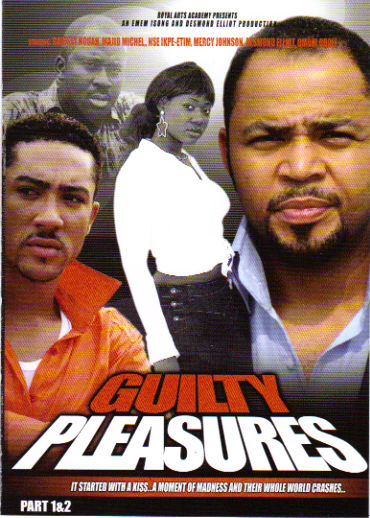
Guilty Pleasures

By Ali Baylay

Starring: Ramsey Nouah, Magid Michel, Nse Ikpe-Etim, Mercy Johnson, Desmond Elliot,Omoni Oboli; Screenplay: Uyai Ikpe-Etim/Bula Aduwo; DOP: Austine Nwaolie/Issac Martins; Executive Producers: Emem Isong, Desmond Elliot; Editor: Uche-Alex Moore; Producers: Emem Isong, Desmond Elliot; Director: Daniel Ademinokan; Assistant Director: Desmond Elliot. c.2009

Guilty Pleasures is one of the few Nollywood productions that’ll surely go into cinematic history as a classic. To a large extent it has the makeup and flare of Citizen Kane. Terso in Guilty Pleasures shares the insolence and self righteousness of Orson Welles in Citizen Kane in his Zanadu mansion.  Just the way Welles idolizes Susan Alexander, so Terso idolizes Liz in Guilty Pleasure and they do so to a fault that cause their happiness to go asunder.

Guilty Pleasures is a narrative of two divorced wives telling how they were each robbed out of their marriages. Each story has a semblance of classic Hollywood: Citizen Kane on one hand and Fatal Attraction on the other. The stories are told interchangeably by the two and the screenwriters Uyai Ikpe-Etim and Bula Aduwo do so cleverly without confusing viewers. In one account the wife throws the husband out, and in the other, the rich husband cannot help but throw the pig back into the sty.

Kinetchi (Rob Loner) is a photographer who on a gig, runs into Boma (Mercy Johnson) and have a one night stand with her and vanishes out of his life at least, for a moment. Later, their path crosses and it is portraits after portrait at the beach and a night at her pad. When Kinetchi too vanishes obviously on a honeymoon with a newly wed, Boma is stressed out and goes into a massage parlor. While there, the newly wed wife Nse (Omoni Oboli) visits and she’s introduced to Boma and found out that Boma is an interior decorator.  She invites Boma to their house for a dinner and sleepover. Boma,  having come to know this lady stole her heart jumps on the invitation. While Kinetchi’s wife sleeps, he tiptoes into Boma’s room more to satisfy an insatiable desire for her than for her to get out of his life. They’re caught having it out in the living room and he lost the marriage.

The other guilty pleasures take place in the household of Terso. He is a wealthy man of good taste who showers his wife with anything beautiful, but his attention. Terso’s attention could not be dissuaded from his business meetings and trips in exchange for the attention to his wife, so when Terso’s wife takes his photographer younger brother Bobby (Magid Michel) from the airport, at first there’s love-hate introductory relationship between them.  Bobby is young and hot, and every young girl’s dream, especially any girl posing for his camera will fall under his spell and warmth, as did his brother’s wife Liz, an old model. She in turn has been missing the glare and glamour of showbiz coupled with Bobby’s presence in the house, fills the vacuum created by Terso’s absence from her bedroom. She falls prey to Bobby’s almost psychotic gesture towards her, and allows him to deflower the long buried flame of desire in her. That is how Eve (Liz) left Eden.

One cannot review this movie without looking at the line up of the cast. No one other than Ramsey Nuoah would have played the character of Terso more exactly than himself. He has the persona and the perfect grit  for the role. Ramsey has played mostly affluent Nollywood roles to the point that he can be typecast. Most of all, forget the skin tone, the camera loves him. He doesn’t pose he acts and he delivers in Guilty pleasures. Other surprising acts that capture ones attention are those of Magid Michel and Mercy Johnson. Both roles are either psychotic or bordering on  neurotic. You can hear it in their deliveries, in their actions, their laughters and in their behaviors. I think the authors of this remarkable work are portraying artists as loonies.

If there’s a focal attention in Guilty Pleasures, that attention belongs to Ramsey Nouah. Like I said earlier, his acting in this flick is a carbon copy of Orson Welles at both the height of his glory and his downfall-losing his wife. And he acts with such integrity and persona that George Clooney would envy. In the whole movie he’s neither too aloof in the beginning nor softhearted in the end.

I can bet my bottom dollar on Guilty Pleasures to make your evening grande. The energy that went on to produce this movie is visible on the screen. Thanks to Desmond Elliot and partner for having such a sumptious production. An engrossing story! Guilty Pleasures is a romantic, nostalgic, and a sentimental presentation, period. 

» 3 Comments

Unwritten

By Ali Baylay

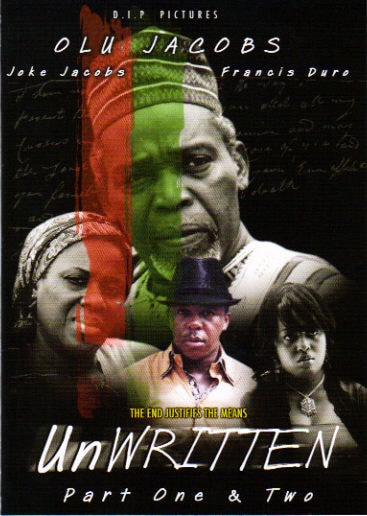
EXECUTIVE IMAGE MOVIES and FRANCO FILMS. Starring: Olu Jacobs, Larry Koldsweat, Alex Osifo, Saidu Balogun, Francis Duru, Bimbo Akintola; Screenplay/Director: Akinlosotu Femi Despy; Producer: Larry Koldsweat. 145 mins; C 2009.

 AFTERWARD: Nnamdi marries Sandra, Scorpion marries Iky. The law finally caught up with Sandra and Scorpion and they served two years each, Chairman served 20 years. Nnamdi pays the medical bill of his bad uncle, Iche Okorie, and also pays the university tuition for the uncle’s daughter.

Unwritten is a drama based on one  family’s land dispute between the son, Nnamdi (Francis Duru), the rightful owner and his uncle, Iche Okorie (Alex Asifo), who wrongfully claims ownership. In the process of owning the property, he plots with the police, to pin armed robbery on Nnamdi but as his good luck should have it, he’s able to escape to the city in search of a friend but unluckily falls in the hands of a gang of three women who live by crime and reports to a hoodlum who goes by the name of Chairman.

unwrittenUpon falling in the hands of the gang, the leader, Sandra (Bimbo Akintola), sexually depraved,  assumes influence over the vulnerable Nnamdi and even to the point of having him in bed but she’s disappointed and annoyed but keeps her cool until they use Nnamdi in one of their capers and Scorpion kills a man. Nnamdi with his saintly character gets the true nature of the group which habors him and runs from there into an old friend, who hires him as a driver.

While driving one night, he happens upon a heist just taken place and rescues a young lady.  Sandra and her gang are the culprits, unbeknown to both him and the gang, but the lady forgot her purse in Nnamdi’s car. Upon returning the handbag to the owner, Nnamdi finds himself account position in a construction company belonging to her father, Alhaji Usman (Olu Jacobs), who’ll not allow Nnamdi have relationship with his daughter, for differences in religion and culture. Sandra on a visit to Alhaji, obviously her sugar daddy, discovers Nnamdi in his employ and soon after while Nnamdi is fired from the job, Sandra and her gang go on the run from the law. Meanwhile in the village, the wicked uncle is fallen onto hard times, abandoned by both his wife and two sons recently deported from America. Alhaji comes face to face with Nnamdi,  over the sale of Nnamdi’s land to him. Alhaji is subdued, humbled and ashamed once he finds the true sense of integrity in Nnamdi, and even allows Nnamdi and his daughter have tit a tete, something unimaginable before this meet. Film ends.

Unwritten has two distinct plot lines: family feud based on land and a caper. Writer/Director, Akinlosotu Femi Despy, puts too much on his plate in this movie but manages to pull it off by stage managing the two plots as a counterpoint to each other until they converge amicably at a successful resolution. Though these two themes could have run independent of each other, as they did sometimes leaving one theme hanging in the air for almost half an hour,  in the process of interweaving them, Depsy did commit a literary crime of interjecting surprising scenes and incidents with no cause and effect. I feel cheated but all the same grateful for a wonderful production.

» No Comments